World Map & Regions
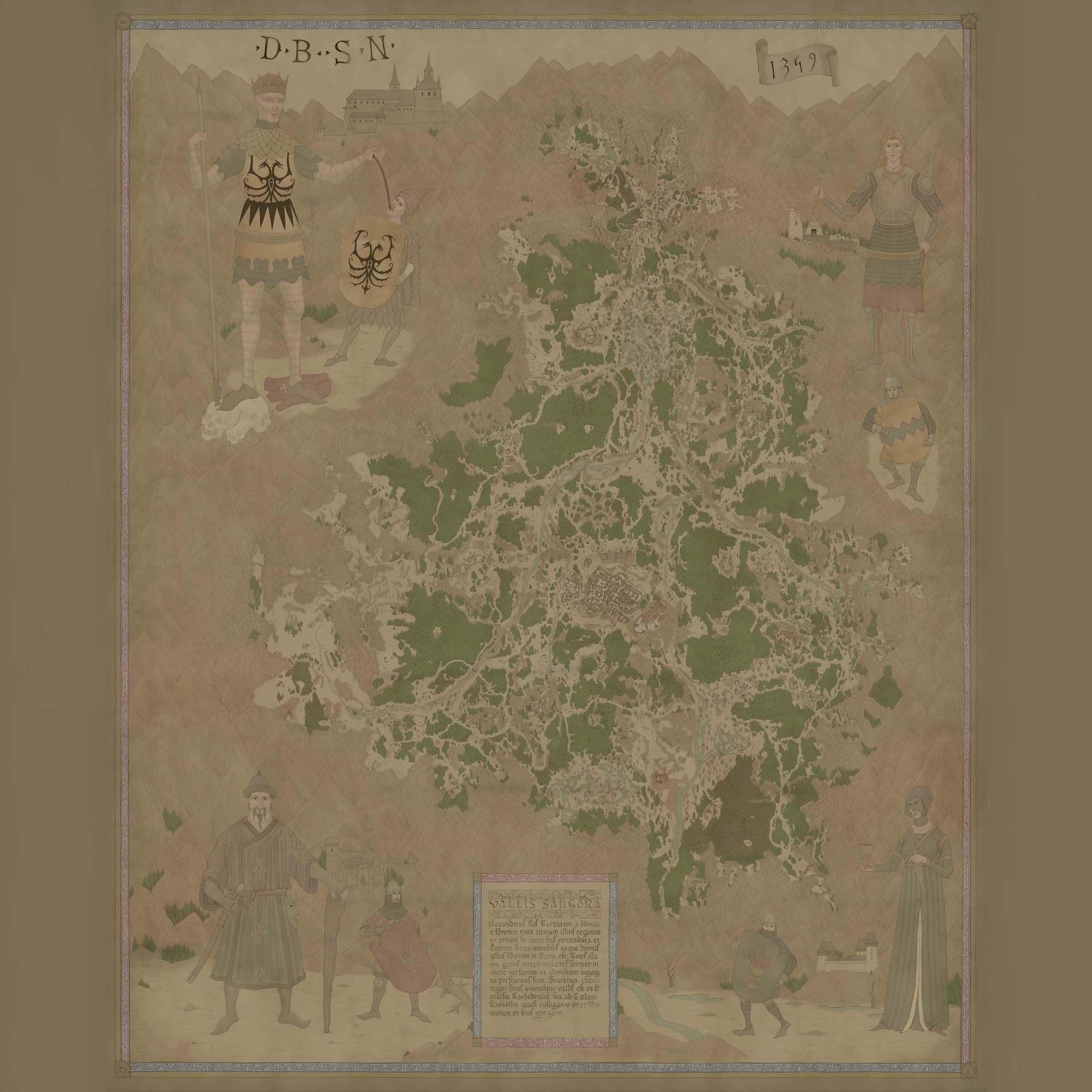
The full Vale Sangora map: all regions from Laslea Glen to Tantari Woods, the four vampiric fiefdoms, biomes and travel routes.
Vale Sangora is a fictional valley, but it stands on very real ground: the Carpathian Mountains of Central and Eastern Europe, in the year 1349. The setting leans on that realism — a mountain valley ringed by peaks, ruled from a central city, with the whole map divided between four vampires who carved it into fiefdoms the day they took the valley.
The Four Fiefdoms
Each corner of the map belongs to one of Brencis's vassals, and each rules their territory as they see fit — Ambrus with his leech camps and blood transports, Bakir with his dungeons, Xanthe with her guards and recruiters. The exception is the middle: Svartrau City is nominally shared ground, though with Brencis's castle looming over it from above, everyone knows whose city it really is.
| Vassal | Corner | Origin |
|---|---|---|
| Brencis | Center — rules everything, castle above Svartrau | Former Roman senator |
| Ambrus | Northeast | Vrakhir of the old blood |
| Bakir | Southwest | Central Asia |
| Xanthe | Southeast | A remote Greek island, long ago |
For the Court activities that anger each of them — and the duels that follow — see the quests page.
Regions of Vale Sangora
The named regions, north to south. Enemy difficulty follows the same gradient: the further south you push, the higher the level of what's waiting for you, color-coded on the map itself.
| Region | What it is |
|---|---|
| Laslea Glen | Coen's home village in the north — where the prologue plays out and the story starts |
| Briar Sloughs | Marsh and swampland directly below the Glen; slow ground, early treasure routes |
| Maragir Wealds | Deep forest east of the sloughs, thin on civilization, thick on things to find |
| St. Tyna's Grove | South of the Wealds, named for the valley's healer saint; her coven once served the sick here |
| Svartrau Outskirts | The ring of settlements around the capital |
| Svartrau City | The central hub — the largest concentration of vendors, quests and the game's verticality, with Brencis's castle overlooking it |
| Boar's Back | The wild northwest, rough country between the city and the high country |
| Rockfalls | Rocky highlands in the south of the valley, hiding old camps and older secrets |
| The Silts | River country — braided waterways southeast of Rockfalls |
| Tantari Woods | The forested far southeast, the last stretch of the valley |
Two regions deserve a note. St. Tyna's Grove carries the name of one of the valley's two saints, a doctor said to cure any illness brought to her — though when the death plague came, many of her coven's nuns died with everyone else, and what remains of the place is no longer what it was. And the swamp southeast of Laslea Glen is where new players are pointed first: close to the start, safely low-leveled, and the prologue's strongest gear routes run through it.
Biomes and What's Layered Underneath
The valley packs several biomes into one walkable space: swamps, forests, mountains, caves and mines, each with its own inhabitants and its own loot. Somewhere on top of all that sit the secret areas tied to the vampires — places layered over the ordinary map rather than drawn on it, including the red, spirit-haunted otherworld the vrakhiri seem to treat as a separate plane. The map doesn't show them; you enter them by finding their doors.
The design philosophy behind all this, straight from the developers: big enough to feel expansive, small enough to stay dense with content, with gameplay systems prioritized over sheer scale. And the valley is vertical — mountains everywhere, and the vampire's traversal is built for them: Shadowstep to blink behind an enemy or up a wall, Planeshift to scale sheer faces, claws to slide down cliff edges that would kill a human.
Reading the Map
A few things the hand-drawn art doesn't spell out but the game expects you to know:
- Difficulty is geography. The map color-codes danger by area — yellow, orange, red as you push into harder country. Red-skull areas will one- or two-shot an early Coen, but the gear in their chests is proportionally better.
- Towers are for the night. Scout towers can only be climbed in vampire form and reveal everything around them. Knock out every tower in a new area the first night you arrive.
- Shrines are the road network. Fast travel runs shrine to shrine, costs no time, and shrines double as storage. There are plenty already standing — restoring broken ones is rarely worth the two hours.
- The center is the hub. Svartrau holds the biggest vendor cluster and most of the game's trading, and it sits close enough to everything for a hub-and-spoke loop once it's unlocked.
For what to actually do in each region — quests, activities, the loot worth crossing the valley for — the quests and guides pages have the details.
Last updated: 2026-09-04